
Unbeknownst to many young boys, a silent killer lurks in many homes.
It’s pretty funny.
Then again, it’s really not.
Unbeknownst to many young boys, a silent killer lurks in many homes.
It’s pretty funny.
Then again, it’s really not.

Here, Kitty Kitty
Eartha Kitt died Christmas Day of colon cancer at the age of 81.
An Emmy-winning actress and Grammy-nominated singer, Kitt was better known to me (and let’s face it, that’s what counts) as one of the actresses who portrayed Catwoman (1967-68) on the original Batman TV series.
Her purr will be missed.
As Christmas approaches, I think most Americans would be hard-pressed to ignore some of the ugly stuff that’s going on with our economy.
Every day brings more discussion on bailouts and the mortgage crisis and layoffs. It’s nearly impossible to ignore.
The climate in my profession, journalism, is no different than in any other section of the economy. In fact, I could probably support an argument that journalists started feeling the downturn long before most American realized there were any problems.
Long-term transition from a print-based product to a Web-based or multi-media product notwithstanding, newspapers, magazines and television all derive their proffits from advertising, and ad revenues have been dropping for some time.
While some of that is the result of what many believe is the slow death of newspapers, much of it is simply advertisers advertising less because they’re making less.
So our bosses’ bosses need to cut costs and the best way to do that is cut people. As a result, I work in an environment where there is the constant rumor of layoffs or buyouts or early retirement.
In fact, twice in the past year, there have been significant layoffs in our newsroom. The ones laid off face a sudden, undesired career change, while the ones that remain are asked to do more with less.
The obvious solution is to get out. As it is, this is a career where most newsroom employees could make more in another profession. Most newsroom employees in this country make less than the pretty-people drug reps that you see visit your doctor in droves while you cough up a lung sitting in the waiting room.
And, while they make less, their job is exponentially more important. It might seem idealistic, but if they are doing their job, journalists are the watchdogs in this country. They call foul when our leaders and our heroes cross the line.
For a while, even though people in my newsroom had lost their jobs, aside from my former boss being pushed into retirement, it had still managed to remain impersonal to me.
But lately, it’s gotten rough for me.
This past summer, I was in Reno, Nev., with eight other editors as a Reynolds fellow in the Maynard Institute’s six-week summer editing program. In the four months since the program ended, two of our nine are already without jobs.
If that wasn’t enough, a friend I worked with here for close to eight years has been laid off at his newspaper. It’s tough just to figure out how to approach the subject with him.
I went to school to be a history teacher. If I don’t wait too long, I can teach history or English or whatever in any number of districts here. I have a family I need to provide for and that has to be my top concern.
But I know if I get get out … there’s no getting back in. And I love what I do.
Every day, I struggle on the inside. How long should I wait before reaching out in a different direction? Should I look for another job in journalism somewhere else? How much longer do I have to stay here before another opportunity to improve my standing improves?
If you know the answers to those questions, you’re doing better than me.
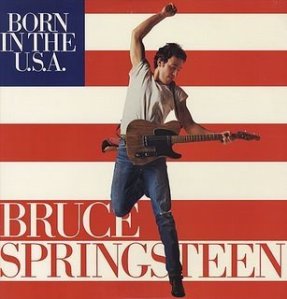
"Born down in a dead man's town ..."
I find this funny.
Several pop and rock musicians are protesting the U.S. government’s use of popular songs as a way to torture detainees at places like Guantanamo Bay.
According to published stories, Bruce Springsteen’s “Born in the USA” is one of these, along with tunes by artists like Britney Spears and Rage Against the Machine (a natural pairing if ever I’ve seen one).
What makes it funny to me is that my wife, Brooke, has probably considered “Born in the USA” to be torture for some time.
Somehow (there’s some sarcasm here), mysteriously, it’s become Dylan’s favorite song. In fact he knows the words so well, if I try and slip the acoustic version by him, he recognizes it as well.
In fact, it’s only one among several songs that he likes that she could do without. He’s also a huge fan of Warren Zevon’s “Werewolves of London.”
Brooke … she hates it, especially when it’s played over and over (Who would do that?).
And he loves anything by Johnny Cash.
Fine by me.
Torture?
Nope.
That would be Celene Dion.
 | macmystery on In memory of a teammate |
 | Cate on In memory of a teammate |
 | Frazzled Daisy on This … is Jeopardy! |
 | Treasa Nicewander on The Freedom Rides turn 50 |
 | Zievah Flynn on A strange anniversary |
 Raising Two Americans